Most of life is lived by sight. We choose what feels safest. We move forward when the path looks clear. We trust what we can measure, explain, and control. That kind of living feels responsible and sensible, and in many ways it looks like wisdom.
But Scripture keeps calling believers to something deeper. God does not merely save us so we can attend church and blend in with a religious crowd. He saves us so we can live a life that pleases Him, a life worthy of the salvation Christ purchased for us. That kind of life will not be governed by what we can see. It will be governed by what God has said.
In 2 Corinthians 5, Paul is writing to a church that had real struggles and real pressure. They were facing the complexities of life, and in that tension, Paul places a clear, simple truth at the center: a believer’s daily walk is meant to be faith-led. Faith is not something we visit only in a crisis. Faith is the road God calls us to walk every day.
Paul begins with certainty, not speculation. He writes:
“For we know that if our earthly house of this tabernacle were dissolved, we have a building of God, an house not made with hands, eternal in the heavens.” (2 Corinthians 5:1)
That word “know” matters. Biblical faith is not wishful thinking. It is settled confidence rooted in the promises of God. When life feels fragile and uncertain, faith anchors the soul to what God has already declared to be true.
From this passage, we are pointed to several comparisons that expose the tension we all feel. Each one presses the same question: will I walk by faith, or will I live by sight?
1. Our Present Circumstances vs. Our Future Glory
Paul speaks honestly about life in the present. He describes groaning and being burdened. He does not pretend that following Christ removes the weight of hardship. There are seasons where life feels heavy. Relationships strain. Sickness interrupts. Finances tighten. Stress piles up. Sometimes you wake up, and your heart already feels tired before the day even begins.
Yet Paul refuses to let today’s burden become the final word. He points the believer forward. There is a future glory that is real, lasting, and certain for every child of God. This life is not the end of the story. God has prepared something eternal for His people, and the heaviness of now must be interpreted through the hope of what is coming.
This comparison changes how we handle the pressure of life. If this world is all we have, then every loss is crushing. But if heaven is real, and Christ is faithful, and eternity is secure, then today’s burdens do not own us. They may weigh on us, but they do not define us.
2. Our Earthly Dwelling vs. Our Eternal Dwelling
Paul uses vivid language: an “earthly house,” a “tabernacle,” a temporary dwelling. He is speaking about more than physical homes. He is speaking about our bodies, our current earthly existence. This life is like living out of a suitcase. You can function, you can travel, you can get through the days, but deep down, you know it is not permanent.
That is why Paul says we groan and long to be clothed with what is from heaven. There is a longing in the believer that recognizes, even in the best moments, there is more than this world can offer. If this world fully satisfies us, something is spiritually off within us. God did not create us to find our deepest comfort in temporary things.
Our earthly bodies and earthly life can pull us away from faith. We wrestle with weakness, aging, and limitations. We battle fear, anxiety, and discouragement. We crave comfort, control, and approval. We feel disappointment when life does not turn out the way we expected. All of these pressures tempt us to live by sight, to cling tightly to what we can manage.
But God reminds us that this “tent” is not our forever home. If we treat the temporary like it is permanent, we will be crushed when it starts to fall apart. The believer’s stability is not found in making this life last forever. It is found in knowing that God has already prepared what lasts forever.
3. Faith vs. Sight
All of this leads to the heart of the passage. Paul states the principle plainly:
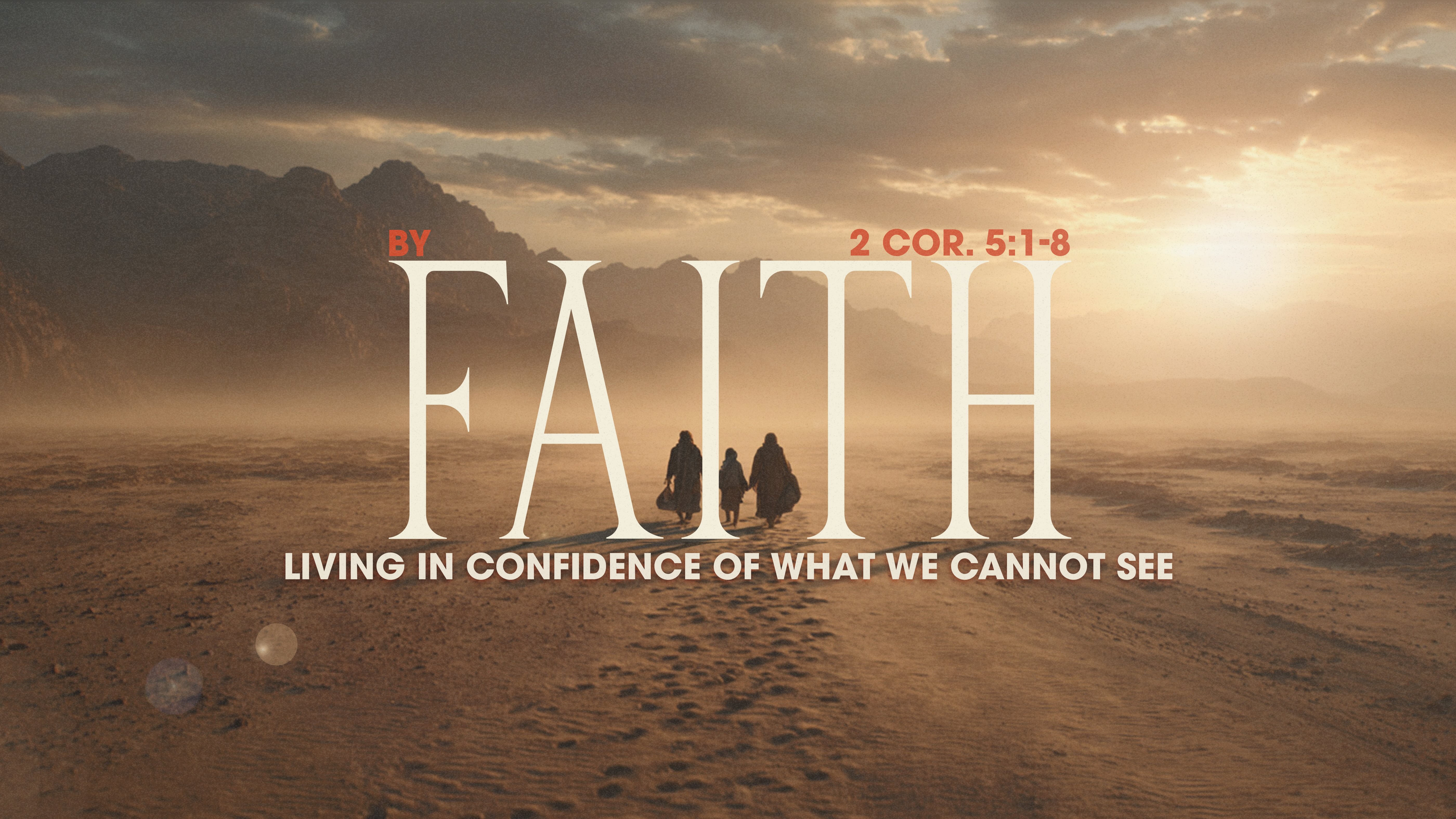
“For we walk by faith, not by sight.” (2 Corinthians 5:7)
Paul is not denying facts. Circumstances are real. Pain is real. Bills are real. Problems are real. But they are not meant to be the governing authority of the believer’s decisions. The Christian life is not controlled by what we see, but by what God has revealed.
This is where the challenge becomes personal. What would change in my life if I walked by faith and not by sight? Many people will trust Christ for eternal life, but then demand sight for daily life. They say they believe God can save them, but they live as if God cannot be trusted with their decisions, their relationships, their finances, their emotions, or their future.
Faith living is learning to let God’s Word lead, even when it does not feel natural, even when it does not look safe, and even when it costs something.
Three aspects of faith living
Faith trusts before it sees.
Faith says, “Lord, I do not know how this will work out, but I trust You.” It does not wait until everything makes sense. It leans on God’s character before the outcome becomes visible.
Faith obeys without visual evidence.
It is one thing to obey when you can see the payoff. It is another thing to obey simply because God said so. Faith steps forward when the evidence is not in your hands yet, because the promise of God is.
Faith believes in God before results appear.
Faith does not require immediate proof to keep going. It keeps obeying, keeps praying, keeps doing right, and keeps honoring Christ because God is worthy of trust, even when the results are still forming.
This is why “walking” matters. Walking is daily. Walking is repeated steps. Walking is forward movement even when you do not feel strong. God is looking for believers who will simply keep taking the next faithful step.
A practical challenge for today
Sight-based living asks, “What is safest?” Faith-based living asks, “What pleases Jesus Christ?” Sight-based living waits until the path is clear. Faith-based living moves when God’s Word is clear. Sight-based living clings to comfort. Faith-based living values obedience.
So take an honest look at your own patterns. Where have you been demanding sight? Where have you been leaning on your own understanding more than God’s Word? Where have fear and control replaced trust and obedience?
God has not called you to guess your way through life. He has called you to trust your way through life. He has called you to walk by faith.
Reflection Question
If you truly began walking by faith instead of sight, what specific decision, habit, or fear would need to change first?